

What to do in La Boca: complete neighborhood guide
La Boca is one of Buenos Aires’ most iconic neighborhoods: the birthplace of tango, home to La Bombonera stadium, and the setting for the colorful houses that appear in thousands of photos around the world. In this guide, we tell you what to do in La Boca step by step, so you don’t miss anything this neighborhood has to offer.
Walk along Caminito, the colorful heart of the neighborhood
You’ve probably seen images of that color-filled street in Buenos Aires at some point. That is Caminito: a permanent open-air exhibition framed by the old tin-and-wood houses built by immigrants who arrived in the city in the early 20th century.

Today, Caminito is the living symbol of tango’s origins and of Buenos Aires’ porteño identity. It is a juxtaposition of colors, shapes, and materials that seems to come from another world. Local artists display their works along the street, and the atmosphere is truly unique at any time of day.
Hours: every day, from 10 a.m. to 6 p.m. Admission is free.
If you want to discover the stories behind these streets, we recommend joining our free La Boca tour, where a local guide takes you through the corners tourists don’t usually see.
Visit a conventillo
In the Caminito area, you’ll find the conventillos: the old communal houses where immigrants who came to Buenos Aires from Europe used to live. Each family occupied a small room around a shared central courtyard, and much of the city’s porteño culture was born from that close-knit coexistence.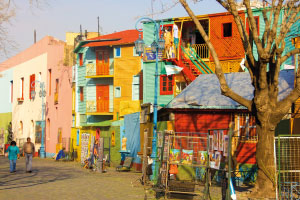
Today, many conventillos house craft shops, galleries, and restaurants. Some are still family homes in the neighborhood. On our tours, we visit Matilde’s conventillo — a La Boca local who opens the doors of her home and tells us the original history of these spaces from the inside.
If you’re lucky, you may well hear live music playing inside one of them.
Admire the Fileteado and street art
Fileteado is a unique decorative art form that was born in Buenos Aires in the early 20th century. It is recognized by its curved lines, intense colors, and symmetrical compositions filled with flowers, ribbons, and ornate lettering. Originally used to decorate the carts and trucks of port workers, it has since been declared an Intangible Cultural Heritage of Humanity by UNESCO.

In La Boca, you’ll see it on façades, storefronts, and murals throughout the neighborhood.
La Boca’s street art tells another story: that of the neighborhood’s longtime residents, their struggles, and their identity. The graffiti murals covering the walls express the passion, pride, and popular mythology of this corner of Buenos Aires.
Boca Juniors football stadium
Boca Juniors is one of the most popular football clubs in the world, and their stadium — known as La Bombonera — is far more than just a pitch. It is a temple, a symbol, and a place of pilgrimage for millions of people.

You can experience La Bombonera in two ways:
- Attend a match: the experience is unmatched. Here we explain how to get tickets to see Boca play.
- Visit the Museo de la Pasión Boquense: a journey through the club’s history, titles, legends, and its bond with the neighborhood. It’s open even on non-match days.
Important tip: La Bombonera is in the heart of La Boca. The area around the stadium is vibrant but requires some awareness — it’s best to visit with a group or with a guide, especially if it’s your first time.
Its stadium known as La Bombonera is practically, today, a temple of football.
Here we tell you how to get a ticket to see Boca Juniors!
Explore La Boca in depth
Each corner of La Boca has its own story. If you want to go deeper into what the neighborhood has to offer, here are some of our guides to its main attractions:
- Caminito: the colorful heart of La Boca
- Museo Benito Quinquela Martín
- MARCO, contemporary art museum
- Fundación PROA
- Usina del Arte
- Puente Transbordador Nicolás Avellaneda
- Plaza Bomberos Voluntarios
- Teatro de la Ribera
- Full day itinerary in La Boca & Puerto Madero
How to get to La Boca
La Boca is located in the south of Buenos Aires city, about 3 km from the center. The easiest ways to get there are:
- Bus: lines 29, 53, 64, and 152 pass through the neighborhood.
- Taxi or Uber: the most comfortable option from the center or San Telmo.
- On foot from San Telmo: about 20 minutes walking, crossing Parque Lezama.
Remember that you can also rely on this simple guide on how to get around Buenos Aires.
Frequently asked questions about La Boca
Is La Boca safe to visit?
Yes, the tourist area around Caminito is safe during the day. As in any neighborhood with heavy tourism, it’s advisable to keep an eye on your belongings and avoid straying too far from the main streets after 6 p.m.
How much time do you need to visit La Boca?
2 to 3 hours is enough to walk through Caminito, see the conventillos, and stop by La Bombonera. If you add the museum or a match, allow half a day.
When is the best time to visit?
In the morning, from 10 a.m. to 1 p.m., the neighborhood is calmer and the light is perfect for photos. On weekends, there is more artistic and musical activity.
Is entry to Caminito paid?
No, Caminito is free and open to all. The Museo de la Pasión Boquense and match tickets do have an admission fee.
Want to explore La Boca with a local guide who can bring all of this to life? Join our free La Boca tour — we go out every day.